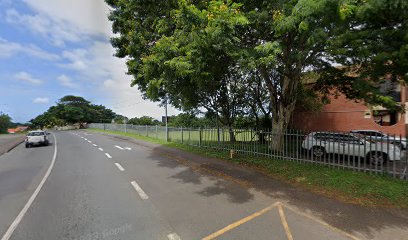
Escombe Primary School is a Primary school establishment in Queensburgh, KwaZulu-Natal, South Africa
Escombe Primary School – overview of services, curriculum and admissions (Queensburgh, KwaZulu-Natal)
Escombe Primary School is positioned as a public primary education facility located in Escombe, within the KwaZulu-Natal province of South Africa. The school sits in the Umlazi District Municipality area and serves learners through the Foundation Phase, Intermediate Phase and Senior Phase, providing a structured curriculum designed to develop knowledge, skills and values relevant to local contexts while aligning with broader national imperatives.
Curriculum and subjects are organised by phase, reflecting a traditional South African foundation where core academic disciplines are complemented by skills and well-being programmes. The Foundation Phase covers Grade R to Grade 3, focusing on Home Language, First Additional Language, Mathematics, and Life Skills. Life Skills includes Beginning Knowledge, Creative Arts, Physical Education, and Personal and Social Well-being, aimed at building early literacy, numeracy and personal development in young learners.
The Intermediate Phase, for Grades 4 to 6, expands the subject mix to Home Language, First Additional Language, Mathematics, Natural Sciences and Technology, Social Sciences, and Life Skills, which again emphasise Creative Arts, Physical Education and Personal and Social Well-being. This structure supports learners as they encounter more specialised study areas and begin to engage with a broader curriculum that links classroom learning to real-world contexts.
In the Senior Phase, represented by Grade 7, the school offers Home Language, First Additional Language, Mathematics, Natural Sciences, Technology, Social Sciences, Economic Management Sciences, Life Orientation, and Creative Arts. This mix prepares pupils for higher education and future careers by incorporating both technical subjects and humanities-, arts-, and life-skills components.
Beyond formal subjects, Escombe Primary School provides a programme of extra-mural activities intended to broaden the learner experience and support holistic development. Participation in extracurriculars is described as beneficial for cognitive function, concentration and time management, while also enabling learners to pursue interests and develop sportsmanship and teamwork. The activities currently listed include:
- Soccer
- Athletics
- Netball
- Speech
There is an emphasis on a well-rounded school environment where learners are encouraged to engage with both academic and co-curricular pursuits. This approach is framed within the broader aim of building resilience, discipline and social skills, alongside academic achievement.
Admission and applications are presented as straightforward, with guidance provided for prospective families on the school’s page. The site highlights several key factors for applicants to consider before applying, including: understanding the school’s curriculum and teaching philosophy, assessing location and facilities, reviewing extracurricular options, and evaluating how the environment aligns with the learner’s needs. The admission process is described as involving the preparation of relevant documents (such as academic records and behaviour reports), and potential interviews or entrance assessments may be part of the process, depending on the school’s requirements.
Typical administrative steps highlighted for prospective applicants suggest engaging with the school to obtain the necessary admission forms and information about how the process unfolds. While specific timelines, fees and contact details are not enumerated on the page, the resource emphasises the importance of visiting the school or contacting staff to gain a clear understanding of the application process and any associated costs.
The page also notes that Escombe Primary School operates as a public school, a status which is generally associated with government funding based on enrolment numbers. This context implies that annual funding and fees are typically aligned with district policy, and parents are advised to consult the school directly for the most accurate and up-to-date fee information and any related costs such as uniforms, transport or additional activities. While comparative fee guidance is provided for public schools in other regions, no explicit fee figure is given for Escombe Primary School itself, and readers are encouraged to obtain current details directly from the school.
Practical tips for potential families include researching the school’s curriculum fit, arranging visits to observe facilities and teaching methods, and preparing documentation early to support a smooth application. As with any school choice, aligning educational goals with the local context and culture of Escombe Primary School is emphasised as a key factor in achieving a positive and durable match for the learner.
Geographically, Escombe Primary School serves the Escombe area within KwaZulu-Natal, South Africa, and forms part of the broader KwaZulu-Natal education system. Specifics such as official hours of operation, best times to visit or the precise range of fees should be confirmed through direct contact with the school to ensure accuracy and timeliness.
Queensburgh
KwaZulu-Natal
4093
South Africa
Sorry, no records were found. Please adjust your search criteria and try again.
Sorry, unable to load the Maps API.
Primary school services in Queensburgh, KwaZulu-Natal
Primary education in Queensburgh typically follows the national framework established for South Africa, with schools catering to learners from Grade R to Grade 7. The focus is on building a solid foundation across core disciplines while fostering personal development, social responsibility and a sense of community. In Queensburgh, primary schools often blend traditional classroom instruction with modern teaching aids, helping pupils develop numeracy, literacy and critical thinking in a supportive environment.
Curriculum and learning approach
Across Queensburgh, primary schools deliver a curriculum aligned with the South African CAPS framework. English and isiZulu (or other local languages) are frequently taught alongside Mathematics, Science, Social Studies, Life Skills, and the Arts. Physical Education, Technology, and Information and Communication Technology (ICT) typically feature as part of a well-rounded timetable. Assessment practices include regular tests, examinations, portfolios of work, and feedback mechanisms designed to monitor progression and identify learners who may require additional support. Many schools emphasise enquiry-based learning, group projects and practical experiments to deepen understanding and encourage collaboration.
Support and special programmes
Learners may access additional help through remedial or enrichment programmes that address varying paces of learning. Schools in Queensburgh often provide teacher-assisted reading support, numeracy intervention, and programmes to assist learners with special educational needs within available resources. Liaison with parents and guardians is commonly encouraged to track progress and reinforce learning at home. Some schools may offer guidance and counselling services to support emotional well-being, resilience and safe decision-making.
Enrichment, sport and culture
Beyond core academics, Queensburgh primary schools typically offer a range of extracurricular activities. Sport is a common feature, with opportunities in athletics, cricket, rugby, netball and football, subject to the school’s facilities and season. Cultural and arts programmes—such as choir, drama, art, and music—are often available, providing avenues for creativity and confidence-building. Clubs and special interest groups may include robotics, environmental clubs or chess. These activities aim to cultivate teamwork, leadership and healthy competition.
Nutrition and after-care
Practical considerations for families include school meal programmes or approved snack options, as well as safe, supervised environments after dismissal. After-care services, where available, can provide supervised study time, light meals, and organised activities until the end of the traditional school day. In some cases, partner arrangements or in-house provisions help ease parental schedules and ensure learners remain engaged and cared for during late afternoons.
Facilities and daily life
Queensburgh primary schools commonly provide classrooms equipped with teaching aids, libraries, computer laboratories or tablet access, multipurpose halls, and outdoor play areas. Libraries and resource centres support independent reading and research skills. Class sizes vary, with some schools aiming for supportive pupil-to-teacher ratios, while others operate with larger groups. Uniform policies and safety procedures are standard considerations, alongside policies on bush-fire, weather and school transport safety.
Parental involvement and community engagement
Many schools in the area value active parental involvement through parent-teacher associations or school governance structures. Regular progress reports, parent evenings and newsletters help maintain clear lines of communication between families and educators. Community engagement may extend to outreach programmes, partnerships with local organisations, and participation in regional events.
Practical steps for families
- Verify the grade range and intake periods for the chosen school.
- Review daily start and finish times, transport arrangements and after-care options.
- Inquire about uniform requirements, meal provisions, and permission slips for activities.
- Understand the enrolment process, required documents and waiting lists if applicable.
- Consider visits to observe classrooms, facilities and the general school atmosphere to assess fit with the learner’s needs.
Overall, primary school services in Queensburgh are geared towards delivering a balanced and inclusive education that supports linguistic development, numeracy mastery and social growth, while accommodating practical needs of families and the diverse KwaZulu-Natal community.